Debbie Friedman
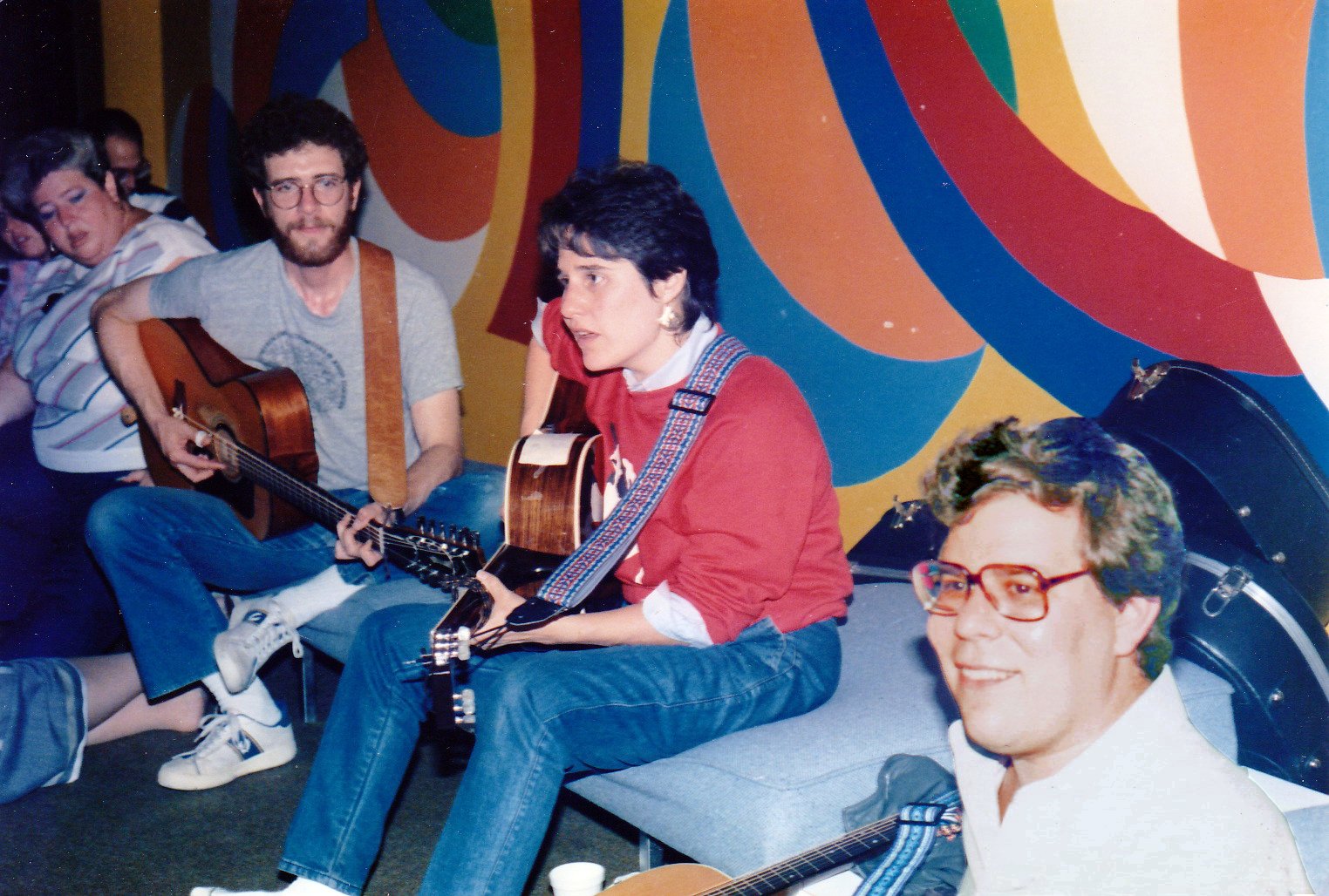
Decades ago, when I was cantor of Beth Emet Synagogue in Evanston, IL, Debbie Friedman came to sing at my shul one Friday night. It was Shabbat Shirah, January 29, 1988. Debbie had concerts in the area on Saturday and Sunday, and somehow I had learned that she was free on Friday. (It was just Debbie - those were the days before "the band.") So I called her a couple of weeks before and invited her to sing with me on the bima—very simple, low-key and haimish. She accepted. There were no ads or emails or phone blasts - with two weeks notice we barely had time to spread the word that Debbie was coming.
I picked her up at the hotel at 6 p.m. I was excited and happy, not just to be spending time with Debbie and singing with her, but to have her be the guest at my congregation on Shabbat Shirah. Little did I know how important a night this would be. For one thing, Debbie had recently written "Miriam's Song". I heard it for the first time an hour before the service, when we sat in my study making a list of songs for the service. Debbie wanted to teach "Miriam's Song," and her new "Mi Chamocha" (the la-la one) and "Kaddish D'rabanan," and "Bruchot Haba'ot," and a song she had premiered the previous summer at CAJE called "L'chi Lach." She sang them all that evening, and I sang and played guitar alongside her, noodling and learning the new songs as she sang them. They would all be recorded (along with "Mi Shebeirach," "T'filat Haderech" and other future classics) for Debbie's first CD release, And You Shall Be a Blessing, an album that would, at the very least, change the direction of synagogue liturgy and perhaps the course of Jewish life.
There was no rehearsal, just enough time to go through her new pieces and for me to show her the chords for "Yism'chu" and "Oseh Shalom." She asked if she could lead "Shalom Rav" and wanted me to follow her. That may have been the first time I heard her unique interpretation of Danny's and my 14 year-old song. When Debbie sang "Shalom Rav" she would pause for a long time after each verse, before the chorus. That's the way you often hear it sung at camp and in youth groups. The long rests Debbie added to "Shalom Rav" (what musicians call "the spaces between the notes") are the musical equivalent of what Kabbalists call "white fire" — spaces of nothingness between the letters of a Torah scroll, which hold all the secrets of the universe. They are very spiritual moments, and a reminder to all of us that it's not whatyou sing but how you sing that makes the difference.
After the service Deeana and I (we had been married for four months) brought Debbie to our apartment to eat something (all she wanted was chicken breast and cucumber) and schmooze for awhile. Then it was getting late, so I drove Debbie to her hotel, and of course saw her at the other gigs that weekend. It was a momentous Shabbat, but only in hindsight do I appreciate just how important it was. Within a month or so, as Debbie relates in the liner notes to And You Shall Be a Blessing, "after lying down with a headache, I awoke incapable of walking. A week later no part of me would move." From that point on Debbie struggled with a neurological condition that changed the course of her life.
By some fortunate miracle, not only was the service recorded (in mono) on our taping system, but the sound is actually pretty good. You will hear everything that happened that night, except for the spoken readings and the Torah service (which included the welcoming of a Jew-by-choice named Joyce, for whom Debbie sings "Bruchot Haba'aot.") We began, at my request, with "Shir Hama'alot." You will hear the spontaneous harmonies, my half-baked guitar riffs, and Rabbi Peter Knobel singing along or tapping the podium when he stands near the mic. You'll hear me introduce "Miriam's Song" by mistake (instead of "Mi Chamocha") and you'll hear Debbie scold me for making up some banter about staying up late at night during CAJE conferences. You'll hear Debbie and me saying how wonderful the other is, and Rabbi Knobel saying how wonderful we both are, and you'll hear the most beautiful version of "Shalom Rav" ever sung, with a break of several seconds in the middle from the cassette changing direction.
What you won't hear is the closing song, "L'chi Lach." The tape ran out just before Debbie was about to sing it. When you hear the last words I say as the tape cuts off, you'll shudder, just as I did hearing it for the first time a few months ago. Yes...the tape had been lost for 23 years, sitting among hundreds of old cassettes in a cardboard box, until Debbie died, and I went searching through every box of tapes in my house to find it. For a 24 year-old recording on a cheap cassette, I do think it sounds pretty darn good, maybe even great. Click the "Listen" button and see what you think.
A few decades before young Jackie entered the picture millions of East European Jews poured into New York in search of a better life. Beyond their meager belongings, they brought to this country a culture that would define theirs and succeeding generations: the Yiddish language, with its literature, press, theater, comedy and music; a culture of food, beloved dishes such as pastrami and knishes, known today as “delicatessen” (deli); and most important, by a style of synagogue worship whose towering figure was the chazzn.
The story of Jackie’s early career is told in a 2005 film, A Cantor’s Tale, directed by Erik Anjou. It is a film punctuated by stories and tall tales of Jewish life in Brooklyn, circa 1950, where even the deli man could sing a respectable Shema Koleinu, and fans of one cantor or another would walk home from shul debating the merits, faults, and idiosyncrasies of the great chazzanim, whose stardom rivaled the baseball greats of Jackie’s beloved Brooklyn Dodgers.
There is a joke told among baseball fans, “How do you sweep a series?” The answer: “Win the first game!” This wisdom applies equally to the cantorial world. “How do you become a great chazzn?” The answer: “Grow up singing in shul!” For there is no other way to fully absorb the culture, the nuances and repertoire of cantorial art than to literally grow up within it, week by week, year by year.
And such was the life of young Jackie, growing up in that world, a boy soprano in the synagogue choir, where being tapped for a solo was the equivalent of hitting a home run playing stickball with the gang. Jackie’s vocal talents (shared with his older brother Sol, who also became a cantor) had a lot to do with it, but Jackie was also pushed along by his parents. His father owned a delicatessen and was a prominent member of the shul, while his mother, whose love of chazzanut (cantorial singing) superseded everything else, either gave or withheld the approval young Jackie desperately strived to win.
Beneath the humorous stories of A Cantor’s Tale is a darker side, set in motion by Jackie’s mother’s mental illness, Jackie’s own struggle with dyslexia and depression, and his continuing quest to please his parents. Jackie’s road to cantorial glory was not an easy one. It took him years to conquer his demons and establish the vocal technique that would lead to success in the competitive world of chazzoness (accented on the middle syllable,) as cantorial singing is called in Yiddish.
Jackie’s hard work brought him as successful a cantorial career as one could hope for, especially during a time of change in the Jewish world, when synagogues increasingly gravitated away from the classic tradition and toward folk and popular music: serving a large Conservative synagogue near New York City, concertizing around the world, lecturing, teaching student cantors, collaborating with jazz and klezmer musicians, even playing himself in popular movies such as Deli Man (2014), and starring in a one-man musical, A Cantor’s Couch.
Which brings us to the present moment, and the Boston premiere of a new film from the same director, a 2020 sequel titled A Cantor’s Head. Where the earlier movie gave us Jackie’s origin story, kvelling in his well earned success as a cantorial superstar, A Cantor’s Head has suddenly flipped the script. In this very intimate film, Jackie has just learned that his synagogue contract will not be renewed. Is it something about him? His voice? His outside activities? Or is he the victim of forces too powerful for any mortal to withstand? This is a film that any lover of Jewish music and culture, or anyone devoted to synagogue life, should see. It is funny, sad, painful, yet, dare I say, hopeful.
The Jewish people is defined by many things, but among the most powerful is our steadfast determination to pass the tradition from one generation to the next. When that chain of tradition is broken, we are forced to reflect on who we are and where we are going. This film, A Cantor’s Head, does just that. It allows us a rare look behind the bimah and into the soul of one man who has dedicated his life to only one purpose: to sing glorious music to the heavens, and to bring us along for the ride.
LINK TO AUDIO…
